
Link metrics are measurable values that provide insights into the quality and impact of your backlinks. They’re crucial because they allow you to assess the strength of your link profile, identify opportunities for improvement, and, ultimately, enhance your SEO strategy.
Mastering these metrics from the start of your link building campaign is a game-changer. Metrics offer a clear picture of your SEO strategy’s performance, helping you identify successful tactics and areas needing your attention. This knowledge empowers you to refine your strategy, giving you a leg up in the competitive world of SEO.
Furthermore, these metrics serve as a guide for setting achievable, data-driven goals. They provide a benchmark for success and a means to track your progress. With a solid understanding of link building metrics, you’re not just participating in the SEO game—you’re aiming to win.
Now, let’s dive deeper into the significant role of link metrics in SEO and how they can supercharge your link building strategy in 2024.
The Importance Of Link Metrics In SEO
Link metrics are the compass of your SEO strategy, guiding your link building efforts towards success. They provide invaluable insights into the strength and value of your backlinks, enabling you to refine your strategy and enhance your SEO performance.
Understanding these metrics at the onset of your SEO journey is crucial for several reasons:
- Clarity: Link building metrics provide clear insights into the effectiveness of your off-page SEO strategies. They help you understand what’s working and what’s not, enabling you to make data-driven decisions.
- Strategy Refinement: With a solid understanding of these metrics, you can refine your SEO strategy, making it more targeted and effective. You can identify areas for improvement and adjust your tactics accordingly.
- Competitive Edge: In the competitive world of SEO, understanding these metrics gives you an edge. You can monitor your competitors’ link building efforts, identify their successful strategies, and incorporate them into your own SEO plan.
- Goal Setting: Link building metrics allow you to set realistic and achievable SEO goals. By tracking these metrics, you can measure your progress towards your aims and celebrate your successes along the way.
In essence, link metrics are not just crucial: they’re indispensable for any successful link building strategy. Let’s delve deeper into these metrics and how they can supercharge your SEO efforts.
1. Authority Metrics
Authority metrics are pivotal in assessing the value of potential backlinks. They measure the strength and influence of a website, providing insights into its potential to rank on search engine result pages (SERPs). Here are some of the key authority metrics:
Domain Rating (DR)
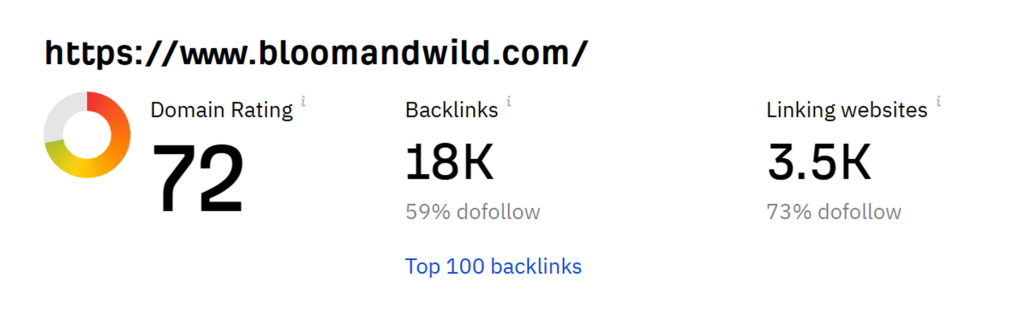
Doman Rating is an Ahrefs metric that assesses the strength of a website’s backlink profile on a scale from 0 to 100. It’s calculated based on the number and quality of external backlinks to a website. It considers both the DR values of the linking websites and the number of unique domains each website has links from.
You need to keep in mind that the metric isn’t a sign of how legitimate or quality a website is. You should always look at the metrics in a context. Depending on your intention and goals, high DR sites could be worse than sites with lower DR. So even though DR can be a highly useful metric and show you how difficult it might be to rank for different keywords, it shouldn’t be the only thing you factor into your decisions.
But what can you do to improve the DR of your site? The metric is calculated on a logarithmic scale, which means that it’s significantly easier to grow your DR from 20 to 30 than it is to grow from 70 to 80. However, improving the DR involves more than just creating high-quality content. It’s about establishing your website as a reliable source of information within your industry. This can be achieved by:
- Getting backlinks from high-DR sites that are relevant to your niche through guest posting, collaborating with influencers, or having your content shared on social media by high-DR sites
- Creating SEO-optimised content that is unique, high-quality and valuable to your audience
- Internal linking and making sure your pages linking to each other where relevant
- Finding broken (i.e., non-working) links on other sites, creating content that matches or outperforms the broken resource, and then telling the website owner about the broken link, suggesting they replace it with a link to your newly created resource
- Searching for mentions of your brand or content that aren’t currently linking back to your website – then you can reach out to the site owners and ask if they can add a link
- Keeping your link profile clean and healthy by disavowing any toxic or spammy backlinks pointing to your site
And when you’re ready to track your progress or need to check the DR of any site, you can use Ahrefs’ tools such as Site Explorer or their free Website “Authority” Checker.
Domain Authority (DA)
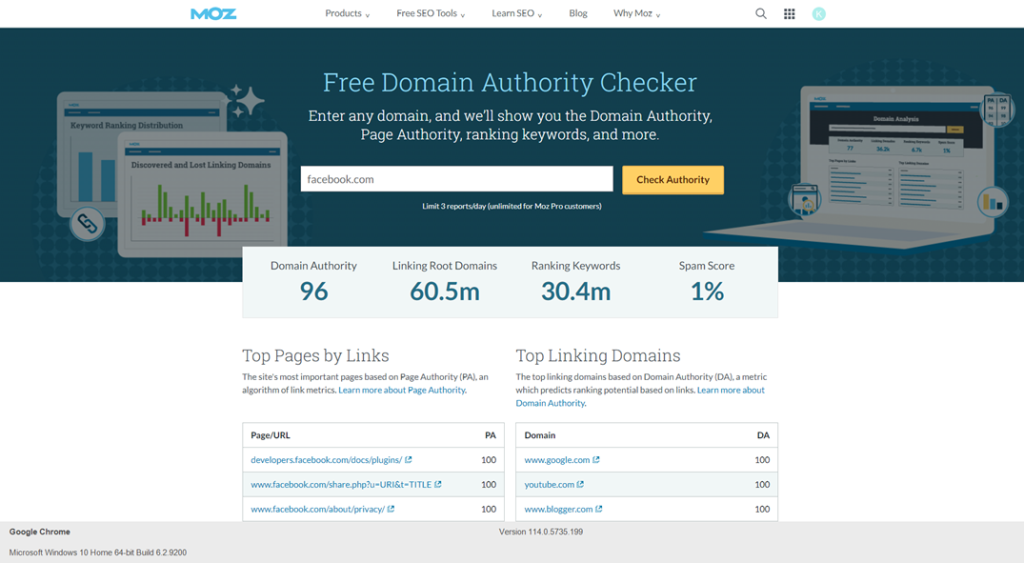
Developed by Moz, DA predicts how likely a website is to rank on SERPs. It’s calculated based on multiple factors, including linking root domains and the number of total links. DA scores range from 1 to 100, with higher scores corresponding to a greater ability to rank.
Domain Authority is calculated by evaluating multiple factors, including linking root domains and the number of total links, into a single DA score. This score can then be used when comparing websites or tracking the “ranking strength” of a website over time.
It’s important to remember that DA is meant to be a comparative metric rather than an absolute one. It should be used to compare the ranking strength of different sites, not to analyse whether a specific on-page SEO change has brought about a certain score improvement.
When you look at the factors that influence DA, it’s not only about how many backlinks you have. The score takes into account the quality of these backlinks, the relevancy of the information on the website, the SEO performance, the duration of the domain, and much more. A strong, reputable website will typically have a higher DA.
Unlike other SEO metrics, it’s hard to influence your DA score directly. You can’t change it in a day. It involves factors that are often difficult to influence directly, such as the linking patterns of other websites. However, the key to increasing your website’s Domain Authority is to improve its overall SEO, especially the link profile, which can be done by increasing the number of high-quality, relevant inbound links to your website.
To check the DA of your or any other website, you can head over to Moz and explore their free Domain Authority Checker.
Citation Flow
Citation Flow is a metric developed by Majestic that predicts how influential a URL might be based on the quantity of sites linking to it. Unlike its counterpart Trust Flow, which evaluates the quality of these links, Citation Flow is better when you need to look solely at the number of links.
The score is measured on a scale from 0-100. A higher score means the site has more links pointing to it, which could indicate more influence or authority. Since Citation Flow doesn’t consider the quality or trustworthiness of the linking sites, it can be easily manipulated. For instance, using link farms or other black-hat SEO practices can inflate the Citation Flow, which is why it should never be looked at in isolation but always together with Trust Flow. When you look at both of these metrics simultaneously, you’ll get a more comprehensive look at a site’s backlink profile.
As with all SEO metrics, it’s important not to focus too much on any single one. Rather, use them in conjunction with each other and with your broader SEO and content strategy. It’s always best to focus on building high-quality, natural links rather than trying to artificially inflate any particular metric.
Page Authority (PA)
Page Authority (PA) is a score developed by Moz that predicts how well a specific page will rank on search engine result pages (SERP). PA is calculated by evaluating multiple factors, including link count and the quality of those links, into a single PA score. This score can then be used when comparing the relative strength of different pages and their likelihood of ranking in search results.
Unlike Domain Authority, which looks at a site’s overall ranking potential, PA measures the ranking potential of a single page. A significant part of the PA score comes from the link profile, which takes into account the number of links pointing to the page and their quality.
PA is based on a machine learning model. It compares the behaviours of sites on the web to understand what characteristics correlate with higher rankings, then scores pages based on these characteristics. You need to remember that your PA can change. When Moz’s index is updated, the PA of your pages might go up or down relative to the link profile data Moz has captured for the web.
URL Rating (UR)
Ahrefs’ metric of URL Rating (UR) reflects the strength of a target URL’s backlink profile on a logarithmic scale from 0 to 100, with the latter being the strongest. It’s based on the number and quality of both internal and external backlinks.
The more relevant a link is, the more likely it is to have an impact on UR. This means that links from pages with similar content are often more valuable for UR than links from unrelated pages.
Ahrefs’ UR score primarily considers “dofollow” links. While “nofollow” links are not entirely ignored, they have less impact on a page’s UR.
To improve your URL Rating, focus on:
- Building high-quality and relevant backlinks to your page
- Improving your internal linking
- Regularly monitoring your link profile to remove any low-quality or harmful links
As with all SEO metrics, UR should be used in conjunction with other metrics and not be viewed as the sole indicator of a page’s quality or likelihood of ranking.
A tip from our outreach expert Kathy:
“Never just rely on one metric, you should always be looking for a combination of different metrics to fully understand if the site is a good fit to build a link from.
- Moz: Domain Authority DA & Page Authority PA
- Majestic: Trust Flow TF & Citation Flow CF
- Ahrefs: Domain Rating DR
- Semrush: Authority Score
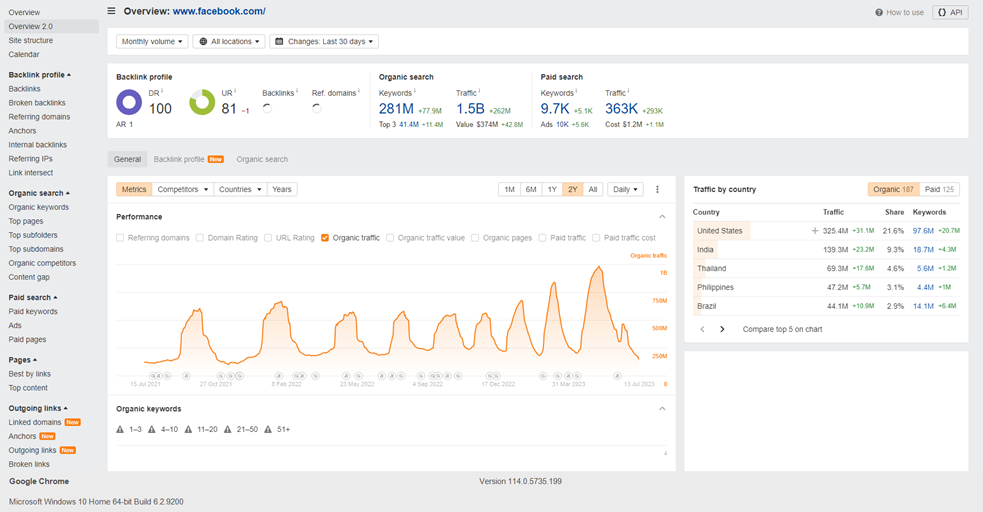
For beginners it might be overwhelming having so many metrics to look – tools will be your best friend to allow you to compare these metrics with the sites you want to build a link off of.
The metrics will allow you to judge the value of a link from a site. You’ll know whether the site is worth pursuing and building a link from if the metrics are strong.
Problem is, there are sites that hit all sorts of spectrum with these metrics e.g. DA 50, DR, 5, TF 2 – then you can get something that’s completely opposite – DA 20, TF 5, DR 25,
You shouldn’t tunnel vision on the numbers but look at the whole picture, this is when you dig deeper to see how trustworthy the site is.
You can’t trust one metric, as they are all built off of algorithms by different brands to calculate a website’s link profile, SEO performance, content quality etc.
So having a good understanding of each metric can let you do data analysis and comparisons with your competitor’s link profile to find those sites worth linking too!”
2. Trust Metrics
When you’re happy with your authority metrics, it’s time to find out whether the sites are worth linking to. Trust metrics measure the trustworthiness of a website and they’re akin to a website’s reputation score in the digital world. Here are the key trust metrics:
Trust Flow
Trust Flow is a metric from Majestic that helps to predict the quality of a website based on the quality of the sites linking to it. The measure focuses on the quality of links pointing to your website, not the quantity. It gauges the trustworthiness of a website by examining how trustworthy sites tend to link to trustworthy neighbours. You can improve your Trust Flow with links from authoritative and trustworthy websites. Even a few links from high-quality sites can boost your score significantly.
Trust Flow is most effective when used in conjunction with Citation Flow, another Majestic metric. This can provide you with a holistic view of the website’s link profile. A high Citation Flow and low Trust Flow could be an indication of a large number of low-quality links.
Majestic also uses Topical Trust Flow, which breaks down the metric into various categories, assessing the trustworthiness of a site within specific topics. This gives you a better understanding of your website’s authority within its niche.
Like other third-party metrics, Trust Flow isn’t a direct Google ranking factor. However, it can provide valuable insights into your link profile’s quality, which does impact rankings.
To improve Trust Flow, focus on earning high-quality, relevant backlinks from authoritative websites. Avoid low-quality or spammy links, as these can negatively impact your Trust Flow. Remember to regularly audit and clean up your link profile to maintain a healthy balance of trustworthy links.
Organic Traffic And Referring Domains
When you’re trying to determine whether a site is trustworthy, you shouldn’t forget to look at its traffic. Look at how many people visit the site and if there are any trends that might be concerning, such as a rapid decline in traffic. And while traffic is important, you should also find out what sites link to the website you want to reach out to. Try to work with sites that are linking to sites in your industry and where you could reach your target audience.
These metrics provides a comprehensive view of a website’s authority and trustworthiness, helping you identify valuable backlink opportunities for your SEO strategy.
Boosting your trust metrics requires building a reputation for reliability and authenticity. This approach involves:
- Ensuring your website is secure, easy to navigate, and provides valuable content.
- Earning backlinks from trustworthy websites. This might involve reaching out to reputable websites in your industry, offering guest posts, or collaborating on content.
Remember, the quality of your backlinks matters more than the quantity. A few backlinks from highly trusted websites can do more for your trust metrics than numerous backlinks from less reputable sources.
A tip from our outreach expert Kathy:
“There are loads of tools to use to do traffic analysis, we like to use Semrush but Ahrefs also have their own too. Stick to one of these as both of these tools also do keywords analysis and can check a site’s link profile.
Why is traffic my recommended trust metric?
Simple. If no one visits your site, tools show there’s no traffic, then what SEO value does that site have? It is going to be very weak and therefore not a site worth building a link from.
You want to look for a traffic profile where the traffic is either growing, or is stable and looks natural. You want to see something happening at least! The more traffic the better, but the actual trends and patterns are more important as a site could have 10K visitors but is declining at an alarming rate.
This is where you cannot just rely on authority metrics, a site could have a DA 50, TF of 20 but have absolutely no traffic. Some sites could have lower DAs of 20 and their traffic is growing.
Other ways to understand how trustworthy a site is its link profile. Are they linking to anything outside of their niche? Does it look strange or spammy? If they’re a site about homes and garden then you wouldn’t want to see a link about gambling in Las Vegas in the link profile.”
3. Inbound Link Count
The count of inbound links or backlinks is highly consequential when it comes to link building. Each backlink to your site is akin to a vote of confidence from other websites, signalling to search engines that your content is valuable.
However, it’s essential to stress that quality matters far more than quantity. Having a multitude of low-quality links can do more harm than good, potentially leading to penalties from search engines that could harm your site’s ranking. On the other hand, high-quality backlinks, particularly from authoritative and relevant websites, can significantly boost your site’s perceived value and contribute positively to your SEO efforts.
A diverse range of backlinks from various domains can further enhance your site’s credibility, portraying a broad base of support to search engines. It’s also worth noting that backlinks can generate additional referral traffic to your site, thereby increasing your organic traffic.
The landscape of backlinks is not static; links can decay or disappear over time. Regularly auditing your backlinks enables you to identify and address these issues promptly. Various SEO tools such as Ahrefs, Semrush, or Moz can provide valuable insights about your backlinks and help you manage them effectively.
Increasing your inbound link count is about making your content irresistible to link to. This might require you to:
- Focus on original research, creating comprehensive guides, or producing engaging infographics that provide value to your audience and are worth linking to.
- Promote your content through various channels such as social media, email newsletters, and industry forums to increase its visibility and attract more backlinks
While increasing the count of inbound links is an integral part of your SEO strategy, you have to ensure these links are of high quality, diverse, and managed efficiently. Be patient, as building a strong backlink profile is a steady and continuous process that yields results over time.
4. Diversity Of Linking Domains
The concept of diversity in linking domains is vital within the grand symphony of link building metrics. It isn’t simply a matter of quantity but about the breadth of unique domains that link back to your site. This diversity is like a testament of your site’s credibility, with each unique domain representing a separate endorsement to your content’s value.
But let’s not forget the golden rule here – quality and relevance are key. Similar to setting the perfect pitch in a musical piece, high-quality and relevant links from various domains strike the right chord, leaving a pleasing resonance that search engine algorithms appreciate.
It’s equally crucial to avoid over-reliance on a single domain for your backlinks. Too many links from a single source might appear contrived to search engines, detracting from the natural and diverse profile that we aspire to build.
Creating this broad spectrum of linking domains doesn’t occur in an instant. It requires:
- A commitment to generating high-quality, captivating content.
- Fostering and nurturing relationships within your industry.
- Regular audits of your backlink profile using reliable SEO tools to identify opportunities and address gaps.
In the grand scheme of SEO, building a diverse portfolio of linking domains is just like conducting an orchestra, with each unique domain representing a different instrument playing harmoniously. The goal is to create a melody that search engines simply can’t ignore.
5. Organic Traffic
Organic traffic, the lifeblood of any website, is a coveted prize in the digital universe. It’s the steady stream of visitors who find their way to your site from search engines, having entered a query and found your site among the top results.
But how do you get the search engines to sit up and take notice of your website? The answer lies in link building and creating a solid SEO strategy. The more quality backlinks you have, the more likely search engines are to recognise your site as a credible source of information. This not only elevates your search engine rankings but also significantly enhances the probability of drawing organic traffic.
Picture your website as a bustling marketplace in the digital world. Each high-quality backlink is a signpost directing visitors towards your marketplace. The more well-placed signposts you have, the higher the footfall. That’s organic traffic in a nutshell.
But remember, this doesn’t mean gathering backlinks at a frantic pace without regard to their quality or relevance. You want quality backlinks from relevant and authoritative sources that align with your site’s content and purpose. These backlinks tell search engines that your marketplace offers value and relevance to the visitors, attracting more organic traffic your way.
Let’s break down the key points to consider when aiming to boost organic traffic:
- Prioritise high-quality, relevant backlinks that align with your content.
- Constantly monitor and audit your backlink profile for potential improvements.
- Regularly update your site with fresh, engaging content that warrants organic traffic.
- Nurture relationships with other websites and influencers in your niche.
Remember, cultivating organic traffic is a journey, not a race. It requires patience, strategy, and commitment to creating content that resonates with your audience and warrants recognition from search engines. So, are you ready to roll up your sleeves and start building towards a torrent of organic traffic?
6. Anchor Text
Anchor text, the clickable words in a hyperlink, might appear to be a minor detail in the grand scheme of SEO. However, its influence is anything but trivial. It’s the spotlight on the stage, directing the attention of search engines towards your backlinks and giving them context. It’s an integral part of your link-building strategy, a subtle yet potent tool in your SEO arsenal.
There are several types of anchor text, each with its own strategic use:
- Exact Match: This is when the anchor text is the exact keyword or phrase that the linked page is trying to rank for.
- Partial Match: This involves using a variation of the keyword in the anchor text.
- Branded: This type of anchor text uses the brand or website name.
- Generic: This is a common type of anchor text where generic phrases are used, such as “click here” or “learn more”.
- Naked URL: This is simply the URL of the page being linked.
- Image Anchors: If an image is the link, the anchor is the alt text of the image.
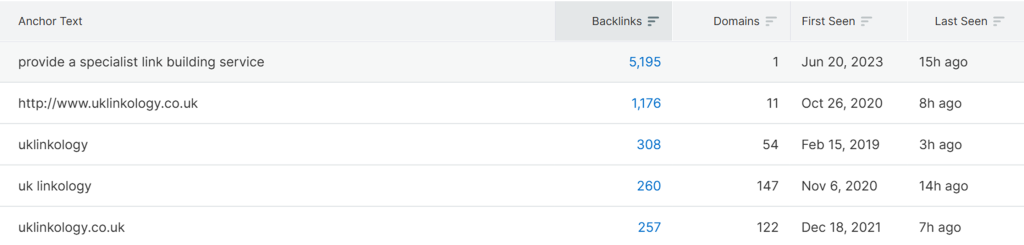
Search engines like Google use anchor text to get clues about the linked content’s topic, similar to a book’s title giving you a hint of the story inside. But, be warned, excessive use of keyword-rich anchor text, or over-optimisation, can lead to penalties from search engines. This would be like a book having the same title for all its chapters—it would appear unnatural and inauthentic.
Instead, it’s vital to maintain a healthy balance and diversity in your anchor text strategy, using a blend of all the different types to keep your profile looking natural and versatile.
To distil it down to the key takeaways:
- Anchor text helps search engines understand the linked content’s context.
- Avoid over-optimisation, as it can lead to penalties.
- Keep your anchor text profile diverse and natural by using a mix of all types.
In short, mastering the art of anchor text can be likened to a well-conducted orchestra, where each type plays its part in the grand symphony of SEO. Your website’s performance depends on this harmony. So, are you ready to create a symphony of your own and ride the wave to better SEO? The conductor’s baton is in your hands.
A tip from our Senior Account Manager Yasmin:
“Anchor text is typically determined by desirable keywords whilst ensuring your maintaining a balance. A key tip would be to ensure that you research user intent when selecting those keywords. Just because a keyword term has a low keyword difficulty and a decent search volume doesn’t mean that it’s the right choice for your audience.”
7. Link Relevance Metrics
Let’s turn our attention to link relevance metrics, an intriguing, complex yet highly rewarding aspect of SEO. Picture yourself at a social gathering. You naturally gravitate towards conversations that resonate with your interests and areas of expertise. Similarly, search engines attach significant weight to the relevance of the links associated with your website.
Link relevance metrics refer to the relationship between the content of your site and that of the sites linking to you. This isn’t just about a link from any high-authority website; it’s about garnering links from websites that are topically related to yours. Think of it as being cited by a leading expert in your specific field. It holds much more weight than a generic acknowledgment from an unrelated domain.
The relevance of a link is determined by assessing various factors, including the content of both the linking and linked pages, the anchor text used, and even the overall theme of the linking website. A high relevance score enhances your credibility in your niche, boosts your SEO, and guides more quality organic traffic your way.
But how do we achieve this? The answer lies in fostering relationships within your niche, creating high-quality, valuable content that others naturally want to link to, and strategically targeting relevant, authoritative websites for backlinks.
Consider these key aspects to better understand the significance of link relevance metrics in your SEO strategy:
- Link relevance is determined by the topical relationship between your site and the sites linking to you.
- The relevance score can be increased by garnering backlinks from topically related, authoritative sites.
- Achieving high link relevance requires relationship-building, quality content creation, and strategic link acquisition.
The journey towards mastering link relevance metrics isn’t without challenges, but the rewards, in terms of improved SEO and organic traffic, are well worth the effort. So, are you ready to dive deeper, understand your niche better, and build a solid foundation of relevant links? It’s time to embrace the challenge and reap the benefits. Your journey towards mastering link relevance metrics begins now!
How To Measure Your Link Building Success
Measuring link building success is a multifaceted process. It involves a combination of several factors, each contributing to a comprehensive view of your SEO performance. Here’s a step-by-step guide on how you can do it:
- Monitor Your Link Metrics: Use SEO tools to track your link metrics regularly. This includes authority metrics, trust metrics, inbound link count, diversity of linking domains, and more.
- Analyse Your Backlink Profile: Look at the quality of your backlinks. Are they from reputable and relevant websites? Do you have a diverse range of linking domains?
- Track Your Organic Traffic: Keep an eye on your organic traffic trends. An increase in organic traffic is a good sign that your link building efforts are paying off.
- Evaluate Your SEO Performance: Look at your search engine rankings for your target keywords. Improved rankings indicate successful link building.
- Adjust Your Strategy Based on Results: Based on your analysis, adjust your link building strategy. If a particular tactic isn’t working, try something new. SEO is all about testing, learning, and adapting.
But what contributes to a successful link building campaign? Here are some of the key factors you need to look out for:
- Quality of Backlinks: High-quality backlinks from reputable and relevant websites strongly indicate link building success. These backlinks can boost your website’s authority, improve its search engine rankings, and drive organic traffic.
- Diversity of Linking Domains: A diverse link profile, with backlinks from a wide range of domains, signals to search engines that your content is valuable and relevant to a broad audience.
- Relevance of Linking Sites: Backlinks from websites that are relevant to your industry or niche can enhance your website’s credibility and authority, leading to improved SEO performance.
Successful link building can significantly improve a site’s SEO, leading to higher rankings on SERPs and increased organic traffic. To evaluate and improve your link building success, regularly monitor your link metrics, analyse the results, and adjust your strategy accordingly.
Conclusion: Start Your Link Building Journey
Getting started on your SEO journey with a solid understanding of link building metrics is like setting sail with a compass—it guides your strategy, helps you navigate the vast ocean of SEO, and leads you towards success.
These metrics, from authority and trust metrics to inbound link count and diversity of linking domains, are your tools for building a robust SEO strategy. They provide invaluable insights into the effectiveness of your link building efforts, helping you refine your tactics, set realistic goals and, ultimately, enhance your SEO performance.
Remember, SEO is not a sprint – it’s a marathon. It requires patience, persistence, and a keen understanding of key metrics. So, don’t wait. Start leveraging these metrics in your link building efforts today and watch your website climb the ranks of search engine results.
And if you’re looking for further assistance and expertise in link building, consider exploring UK Linkology’s services. Our team of experts is ready to help you navigate the complexities of link building and drive your website to the top of the search results.
Take the first step towards SEO success today.
