AI: it’s all the SEO world can talk about.
When the Ologists were in Vegas and at other affiliate shows, all we heard was talk about AI and how it’ll affect our industry.
So we weren’t surprised when we heard that Google was jumping on the bandwagon and launching an AI-based search tool.
The open source ChatGPT and its incredible popularity with users has spurred Google to embrace AI technology and introduce it into its offering.
Named Bard, the tool is powered by Google’s Language Model for Dialogue Applications, also known as LaMDA.
It’s already causing a stir due to early screenshots Google has shared — which is always fun!
We love a bit of controversy, but it could make a real difference to the SEO landscape.
So what is Bard? And why should we care?
Well, as 28.4% of marketers believe that machine learning and AI are the most significant threats to the industry, we felt we needed to explore Bard in more detail and discuss how it could impact our work.
What Is Bard? And Is It Any Good?
Bard is an experimental AI search tool Google is due to launch in the near future. While it isn’t ready yet, it could revolutionise the online search landscape.
The new AI search function will offer fully formed responses to questions, drawing on information from relevant search results.
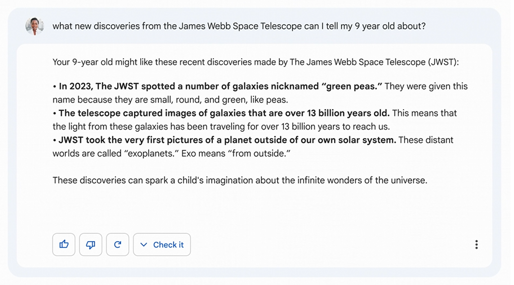
Unfortunately, the tool currently isn’t benefiting Google right now. With the inaccuracy of the above answer wiping $100 bn off Google’s share price, the search engine clearly needs to take a new look at its approach.
Another issue some are noticing with Bard is that, from the initial screenshots, the tool isn’t citing sources, which means it isn’t giving adequate credit to the individuals that actually wrote the information it is presenting.
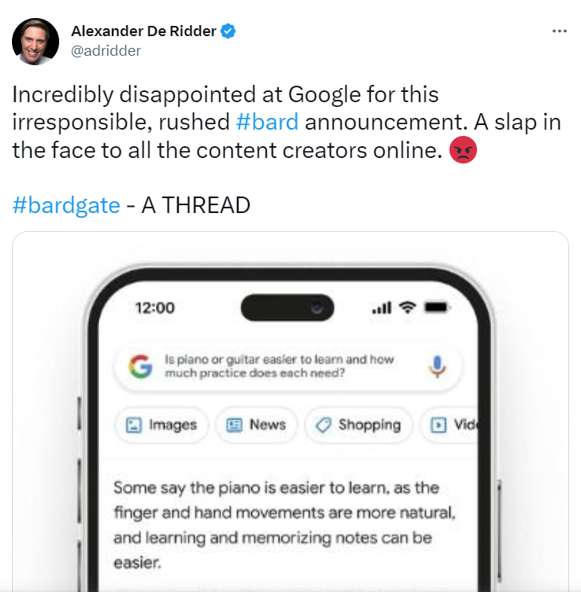
However, as the tool is only in the early stages of development and isn’t even available for use yet, there’s still plenty of time for this to change.
As Google’s entire business model revolves around propelling businesses and websites to the forefront and presenting the best possible results to users, we’re confident that they will start citing sources and that these early screenshots are just an example.
If the tool doesn’t mention where it got its information from, then this guidance will be useless to users, as they won’t be able to verify the facts or find out more information.
So while Bard most probably won’t look exactly as it does currently, it could eventually become the new normal look for search engines.
How Else Is Google Integrating AI Into Search?
Bard isn’t the first AI solution that Google has incorporated into its search process. As AI has become increasingly important to the digital marketing community, Google has been making use of it with inventive tools to save time and improve its output.
These include Bidirectional Encoder Representations from Transformers, or BERT, which Google uses to conduct Natural Language Processing and Multitask Unified Model, or MUM, the upgraded model.
Both tools help Google to understand the true nature of a search enquiry, particularly questions, and to provide the most relevant search results possible.
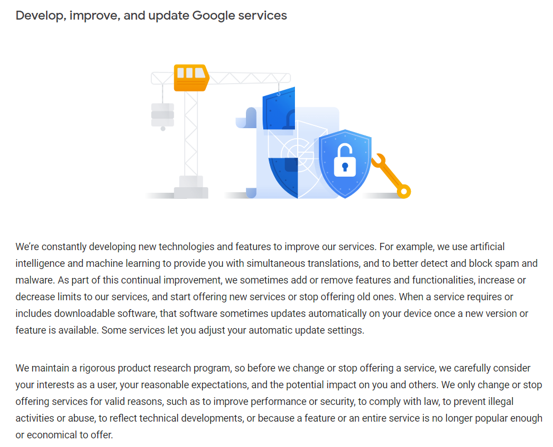
The use of AI by Google to benefit users is outlined in the company’s terms of service, although details of the exact tools used and how they are applied are unclear — Google’s got to have some secrets.
As well as announcing Bard, Google has also been working to allow developers to incorporate LaMDA into their own tools. That’ll mean that other developers can use Google’s cutting-edge AI to create new tools we can all look forward to trying out.
But Wait — Doesn’t Google Hate AI?
Hold up — in the past, Google made it clear they didn’t like AI-generated content and that it’s against its search guidelines.
Recently, in what might look like a flip-flop on these earlier comments, the company announced that AI-generated content isn’t necessarily bad for SEO and that it’s quality that counts, not who — or what — wrote the piece.
So what’s going on?
The fact of the matter is AI has changed, so Google’s stance has too.
In the past, AI content writing software wasn’t very good and often produced content that sounded robotic and was simply unreadable.
Google prides itself on the quality of its search results and on only offering users access to information that meets their needs.
So Google didn’t want this poor-quality content anywhere near its SERPs.
However, as AI has become more usable, Google has realised that it’s being used whether it likes it or not.
That means it’ll have to embrace AI, just like writers have. It might not replace a person, but it can augment their skills and save them time.
With the advent of GPT-3, some of these tools are actually useful for writing and can help. As the world is turning towards ChatGPT and other AI content writing tools and is finding them to be useful, Google has to adapt.
While AI tools might not deliver content that’s good enough on their own, if an AI has been used and the content is relevant, insightful and useful for readers, then Google will accept it.
Basically, Google is highlighting the fact that good content, produced with the assistance of an AI content writing tool, is hard to detect but that it is quality and relevance that still count.
Is It Just Google That’s Incorporating AI Into Search?
No.
The tool will scour the internet and collect a selection of answers designed to give a personal touch, meaning you can ask it specific questions and get full answers.
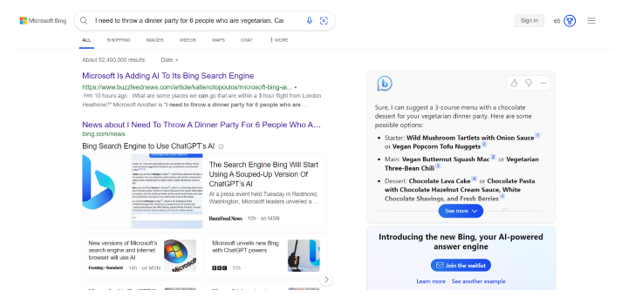
Each answer also shows where the suggestion has come from, so users can access that site and get the full picture.
These screenshots and examples show that Bing’s version of an AI-powered search tool is more advanced than Bard is currently.
It’ll offer links to content, which will benefit creators and businesses, as well as allowing readers to easily find more info.
By combining traditional search with a personal feel that’s similar to ChatGPT, Bing’s new Edge browser could be really fun and helpful, although you’ll need to make sure you fact-check content for accuracy.
How Will This Affect SEO And Content Agencies?
While neither of these new tools is a ChatGPT alternative, they’re both large language models that use a similar approach.
Even with all the controversy and inaccuracy, AI is still a hot topic. Some digital marketing agencies might worry that these tools will make their work obsolete, but there’s one thing you’ve got to remember.
Tools like Bard and Bing’s new AI search browser will need to find their information from reputable sources. That can only mean one thing.
Human content. Content that’s written by a thinking, breathing human who’s able to input facts and think for themselves.
How will these AI content writing tools know what content is relevant, factual and effective? By using traditional SEO ranking factors.
We all know what that means — backlinks!
Experts believe that backlinks are the third most important ranking factor after content and keywords, and UK Linkology agrees.
After all, as we’ve already seen with Bing and Bard, search engines will still be sharing links to sources, so they’ll need to have access to high-quality sites with informative content to show users their AI’s process.
Most of these sites will probably be ranked based on the same ranking factors that search engines currently use, including content quality, relevant backlinks and website responsiveness.
So sites that want to get noticed by these new AI search tools need to focus on traditional ranking factors and creating helpful content.
At UK Linkology, we’ve always known that reliable, heavily researched content written by a person with opinions and an imagination is vital for any website that wants to rank for high-traffic keywords and phrases. That’s why we offer content writing services from our in-house team of experts.
We also know that even the best content isn’t effective if no one sees it. To get your content noticed by search engines for all the right reasons and attracts organic traffic, we offer custom backlink building.
With our help, you can get your site noticed and highlight your expertise in your niche. While an AI tool could save you time, we can take every aspect of your digital marketing and SEO off your hands.
Our group has the skills to offer backlink services alongside digital PR, technical SEO, content writing and planning, so you can carry on running your business, safe in the knowledge that we’ve got your digital marketing covered.
Our experts treat every client’s website like their own. You’ll have access to an account manager who acts as a single point of contact for you and take care of every aspect of your campaign.
So AI helps you complete small tasks, but UK Linkology actually does everything for you. Get the time-saving support you need by scheduling a call with us today.