There are already tons of posts about the Google Helpful Content Update (HCU). And ironically, most of them do exactly what they’re told not to do, which is to regurgitate the same thing everyone else is saying.
Content that does not offer new insights is not original and, as far as Google is concerned, “unhelpful”. With that in mind, it’s odd how much of it is still ranking well; maybe that will change over time but is anyone surprised?

This post will give you some ideas of how the Google HCU might affect link building strategies.
Hopefully, with my 14 years of experience running a 60-strong link building agency, I’ve enough expertise to get this content through Google’s filters to rank. And maybe give you the confidence that what I’ve got to say might be “helpful”.
Quick summary/refresher of the Google Helpful Content Update
I’m not going to list every point and analyse it because that’s been done (again, more unhelpful content), but if you need to read it, here is the link. Google released the Helpful Content Update the week commencing 22nd August 2022.
The Google HCU will target content that does not meet a searcher’s needs. That could be for many reasons, but the main ones are:
- Not offering new or original insights.
- Not satisfying the searcher’s needs (poorly written or clickbait with no answers to the questions asked).
- It Is written to target keyword rankings, not for humans.
- Does not match the topic and audience of your site.
- It Is out of sync with Google’s core update guidelines.
- Does not include expert or first-hand experience of the topic.
- Is written by a machine (A.I. content)
Google has stated they aren’t taking prisoners with this update; if your site has some unhelpful content, the rest of your site will take a kicking too.
Not only that, but it can take months to recover – Ouch. The only way to do that is to remove unhelpful content and replace it with something helpful.

How are backlinks going to be affected?
This post is about how the Google HCU affects backlinks. Backlinks are a part of the content, and the value of a backlink is determined by these factors (and many others helpfully listed by Brian);
- The content it is placed within and how that ranks.
- The location within the content.
- The context of the link placement (why it is there).
- The relevance of the link to the topic.
- The relevance of the link to the site.
- Other links to the page (PageRank flow and other technical metrics).
As you can see, content plays a significant part. If the content on a site is judged to be unhelpful, then that will have an impact on the backlink. The problem we have at the time of writing is how much impact that is.
How you should be producing content for HCU optimised links
Your focus should be on quality across the board.
At UK Linkology, that’s been the case for over a decade. And it’s why we’re actually quite pleased about this update, albeit a bit nervous about the unknown factors.

We see it as an opportunity for sites that publish genuinely good content to shine and for the vapid spammy content to be pushed aside.
But we’re also aware that it could go other ways. For example, Google’s HCU may only target obvious (to them) A.I. content and spun content. Or it could go in hard and kill everything that isn’t judged as expert content – the latter is an issue for everyone that isn’t!
How HCU optimised content will help your brand
Taking a conservative view of how impactful it will be, producing content that goes as far as possible to meet the HCU requirements will do a few positive things for you.
- You will get access to better sites. Smart publishers will be way more careful about who gets invited to provide content.
- You’ll build better relationships with site owners. Site owners will trust you and allow you to publish regularly.
- Your reputation as a writer or brand will improve quickly with Google (good writers will be in a relatively small club).
- The sites you publish on will rank in search, meaning more traffic opportunities.
- Your brand will say the right things to the right audience.
- Your backlinks should have more power.
Investing in better content optimised to meet the guidelines of the helpful content update is simply a no-brainer.
At UK Linkology, we have a team of expert in-house writers. And where necessary, we garner expert opinion from leading industry figures. It’s the only way to guarantee control over the content, ensuring HCU compliance.
What sites should you target for getting HCU-compliant backlinks from?
This aspect is critical. The old ways are dead. Let me say that again but louder because people still aren’t listening; THE OLD WAYS ARE DEAD.
What do I mean?
Assessing sites for link campaigns in detail should be considered crucial; however, it’s always been a side issue for most link builders and buyers.
Not at UK Linkology, never has been and never will be. We believe a website must score well on multiple factors to be suitable for our clients.
How to assess sites properly for Google Helpful Content Update compliance
It’s commonly said in SEO that Google probably uses over 200 factors to rank sites. Many are unknown, but some are known, and others are implied; the truth is we don’t really know.
To simplify, here are the primary data points that are thought to relate to various algorithmic factors, directly or by proxy.
- Backlink quality (indicates the level of PageRank flowing between pages).
- Traffic when relative to other sites in its niche (this indicates that Google trusts the site).
- Keyword visibility (as above).
- Quality of the content (you already know this, and Google makes a lot of noise about it).
- Usability and page speed (the latter is a known ranking factor).
One metric is not enough (nor is two actually)
There are enough clues to enable a sane link builder to accurately assess whether a site will be good for a link if they use the correct method.
We use tools such as Ahrefs, SEM rush, Majestic SEO and Moz, plus some human intervention to achieve this (within a special formula we developed called M-Flux, which I’ll get to later).
However, some link builders still make the same old mistake and use one or two metrics at best. The classic is MOZ DA – a fantastic metric, but even the developers warn not to use it in isolation.
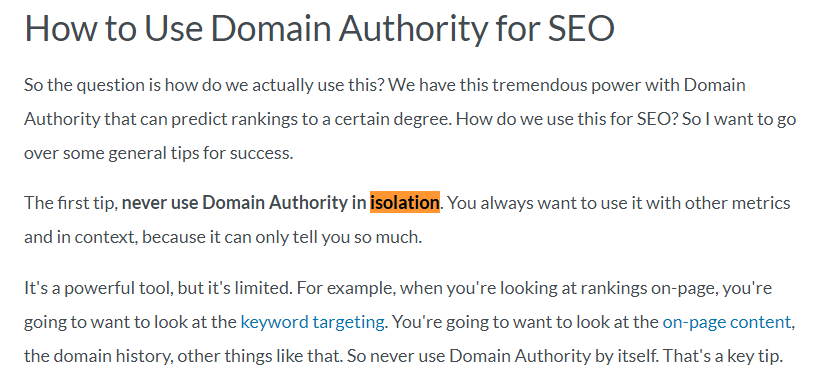
The dangers of this are even starker with the HCU. Imagine thinking a site is suitable for a link because it has a high DA score. Yes, it’s more likely to be better than a low-scoring site, but you could be burning cash if you don’t even check the traffic.
What is M-Flux?
M-Flux (Metrics-Fluidity) is our proprietary formula developed from over 30 years of combined SEO experience (that’s just the directors here) and with the help of a mathematician.

It uses metrics from proven in-the-field SEO tools and weights them accordingly to match what Google values. And that’s why we use “Fluidity” in its moniker. Because when Google changes, M-Flux adapts to stay in tune.
How does M-Flux work with the Google Helpful Content Update?
The Google HCU is putting a massive emphasis on content quality, meaning sites that aren’t up to scratch will lose rankings and traffic. It is logical to estimate that sites that lose traffic will be less potent for backlinks.
To what extent, we don’t know; however, we should pay more attention to traffic and keyword visibility as quality metrics.
For us, using M-Flux makes this easy. We just up weight the traffic data scores in our formula – that is true metrics fluidity and allows for sites to be assessed to the latest Google standards at the press of a key!
Introducing The M-Flux+ Solution (M-Flux “plus”)

Putting it all together, for a successful backlink campaign, you’ve got to produce optimised content for the Google HCU. And target sites that are surviving or thriving through the update, or you will fall behind.
M-Flux+ gives you HCU-compliant sites only
To help you with that, we have developed a new product called M-Flux+ (Plus).
We use the same M-Flux formula, but with the traffic data up weighted so, it’s less influenced by backlink metrics. This ensures that the sites we want to collaborate with are friends with the HCU algorithm.
M-Flux+ uses HCU-compliant content only
We combine this with our Google HCU optimised content. Our writers have, by default, always written for humans, with SEO best practices in mind. Still, we’ve gone a step further and introduced a company-wide writing framework.
These enhancements don’t null our standard M-Flux service (which is still head and shoulders above most link building products) but are designed to take advantage of an opportunity to work with publishers that are usually hard to access and to futureproof your backlink profile.
We’re also offering HCU optimised content to sites that think that may have been hit or want to get on board with a more robust content strategy.
M-Flux+ links are now available on the UK Linkology and Linkologists USA sites.