How to Buid Authority and Manage Risk in Off-Page SEO

Modern off-page SEO is no longer primarily a growth exercise. It is a risk-management discipline focused on how search engines and AI-powered systems interpret brand authority over time.
Authority is no longer accumulated through links alone. It is inferred contextually from a combination of signals — including links, mentions, digital PR coverage, reviews, and wider discussion — and from how consistently those signals reinforce the same topical narrative.

Authority is now interpreted, not counted
Search engines and AI systems assess trust, relevance, and credibility within specific topic areas, rather than transferring authority as a universal score.

Link volume can act as a risk signal
High volumes of misaligned links increasingly introduce uncertainty rather than strength, often leading to stagnation rather than immediate penalties.

Metrics are filters, not decision-makers
Third-party scores such as DR and DA are useful for triage, but they do not explain whether a placement reinforces visibility for meaningful topics.

Links, mentions, and entity signals work together
Links provide structure and trust. Mentions, PR, reviews, and discussion provide context and meaning. Consistency across these signals determines whether authority compounds or dilutes.

Digital PR reinforces authority and reduces risk
Strategically aligned PR helps search engines and AI systems understand what a brand does, where it belongs, and whether it is safe to recommend.

This approach requires operational readiness
Relevance-led authority building works best for teams that prioritise alignment over volume, integrate SEO and PR, and tolerate delayed or indirect impact.

Authority is an ongoing decision, not a one-time outcome
Every off-page placement either reinforces or weakens how a brand is interpreted. Over time, small decisions compound into stability or volatility.
Use the UK Linkology Authority Risk Assessment Custom GPT to evaluate links, mentions, and PR placements:
- Before approval, to assess relevance and downside risk
- After placement, to understand whether activity is reinforcing, neutral, or dilutive
Introduction
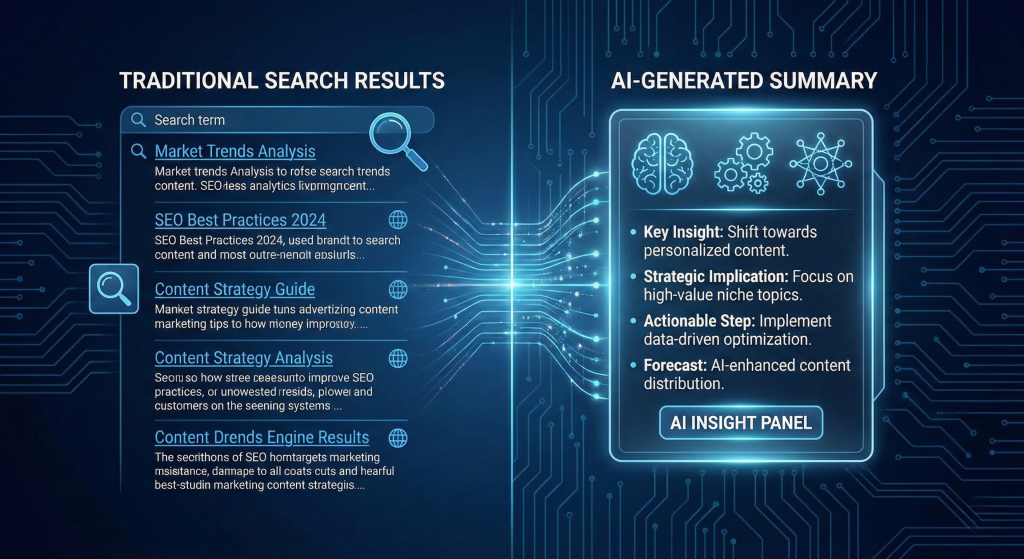
This article explains how brand authority is now built, interpreted, and protected through off-page SEO, and why many traditional link-led strategies no longer hold up in modern search environments.
In this context, authority refers to how confidently search engines and AI-powered discovery systems can interpret a brand as credible, relevant, and trustworthy for specific topics — not simply how many links point to a website.
The article is written for founders, marketing leaders, and SEO teams responsible for long-term organic visibility and brand credibility. It is aimed particularly at teams already investing in link building or digital PR who want to understand whether their current approach aligns with how modern search engines and AI-assisted systems evaluate authority.
It sets out:
- what authority actually means today
- which off-page signals matter most
- and how to reduce risk while maintaining visibility as search technology continues to evolve
How authority is being re-evaluated in off-page SEO

Before discussing how authority is changing, it is important to be clear about what we mean by authority and why it matters in the first place.
In SEO terms, authority is fundamentally a measure of trust. It reflects how confident search engines and other discovery systems are that a brand, website, or entity is credible, relevant, and worthy of visibility for a given topic. Historically, this trust was inferred largely through backlinks. The more links a site earned from strong or established domains, the more authoritative it was assumed to be.
For a long time, authority in off-page SEO was treated as something that could be accumulated. More links, stronger third-party metrics, and higher authority scores were assumed to translate directly into long-term visibility and stability. This created an industry mindset where growth in link volume was often treated as synonymous with progress.
That assumption no longer holds in the same way.
Modern search systems do not simply count off-site signals and pass authority through them mechanically. Instead, they assess context, consistency, and credibility over time. A link, mention, or citation does not exist in isolation. It is evaluated based on where it appears, what surrounds it, how frequently similar signals occur, and whether those signals collectively reinforce a clear and coherent topical narrative.
At the same time, the way people search — and the way information is surfaced — is changing rapidly. Traditional blue-link search results now sit alongside AI-assisted summaries, recommendations, comparisons, and answers. These systems draw on a wide range of indexed content, including editorial coverage in news outlets, videos, reviews, and broader brand references, to form an understanding of which brands are credible within a given space and why.
This raises an important question for anyone responsible for off-page SEO: how do these changes affect off-page signals, and which signals actually matter when it comes to building authority today?
If an SEO strategy remains focused wholly on links, it has not crossed into this new paradigm. Links still matter. They remain a foundational signal and continue to play a major role in how Google and other search engines discover content, understand relationships between sites, and assess trust at a technical level. However, links alone are no longer sufficient to explain why some brands remain stable through periods of volatility while others regress despite continued link acquisition.
There is a direct relationship between how search technology is advancing and the number, diversity, and quality of off-page signals a brand needs to remain visible. In practical terms, this means that building and maintaining authority has become more difficult, not easier.
What we are consistently seeing is that, in most sectors, off-page SEO has shifted from a growth-only activity to a risk-management discipline, with a much stronger emphasis on quality and alignment. Poorly aligned links, irrelevant placements, and disconnected digital PR activity introduce ambiguity into how a brand is interpreted by search engines and AI-powered discovery systems. Ambiguity is rarely rewarded. In simple terms, it is money on the fire.
Building brand authority now is less about acquiring more links, mentions, reviews, and shout-outs, and more about what those signals are collectively saying and how consistently they reinforce the same message. This shift in mindset is crucial, and it should guide how off-page SEO strategies are planned, evaluated, and executed from this point on.

Jason Brooks
Founder

I’ve had this mindset since forever, but it really firmed up in 2012 when Penguin hit. The reality is that the algorithm isn’t consistent across sectors, so volume and trajectory worked in some and others, one slip and you get a penalty. This has meant the link building sector has had to play a game of filling link gaps but maintaining quality — not an easy task.
How link volume became a risk signal, not a growth lever

For many years, link volume was treated as a reliable proxy for progress in off-page SEO. More links were assumed to indicate more authority, more authority was expected to lead to better rankings, and improved rankings justified continued or increased investment. In some cases, this logic can still appear to work on the surface, particularly in the short term.
The underlying problem with this strategy is that link volume is no longer interpreted in isolation.
Modern search systems now evaluate link acquisition across several dimensions at the same time. These include where links are acquired, how quickly they appear, and how closely they align with the topics covered on the site receiving them. As a result, a growing link profile is not automatically a healthy one. In fact, increasing volume without a corresponding improvement in relevance and consistency increasingly introduces uncertainty for algorithms rather than strengthening trust.
This is where, in many sectors, link volume quietly shifted from being a growth lever to acting as a potential risk signal. There are exceptions. Some industries can still absorb higher volumes of links more easily than others, often due to the competitive dynamics of those markets. Online gambling is frequently cited as one example. However, for most brands operating outside these extremes, the tolerance for misaligned or unfocused volume has narrowed significantly.
When a brand accumulates links faster than its wider authority signals develop across areas such as editorial news coverage, video content, reviews, and social platforms, problems tend to arise. Rankings may stagnate or gradually decline, and traffic often shifts toward competitors that present clearer topical positioning and more consistent signals of credibility.
Common risk patterns associated with volume-based link acquisition include:

High volumes of links from sites that are technically strong, as measured by DR, DA, or similar metrics, but are topically disconnected from the brand or content being promoted
Editorial placements that appear credible in isolation but are not relevant to, or focused on, the target audience’s needs
Link velocity that significantly outpaces brand demand signals such as branded search, direct traffic, or repeat engagement
Digital PR placements that generate short-term brand visibility but fail to support long-term topical association
None of these issues typically cause immediate ranking drops or obvious penalties. That is precisely what makes them dangerous. Instead, they tend to result in slow decline or prolonged stagnation rather than catastrophic failure. Performance becomes harder to maintain, harder to predict, and increasingly difficult to explain internally when budget continues to be spent month after month without clear improvement.
Link Volume vs Authority Stability Curve
Without alignment, increasing link volume shifts from growth to noise and risk.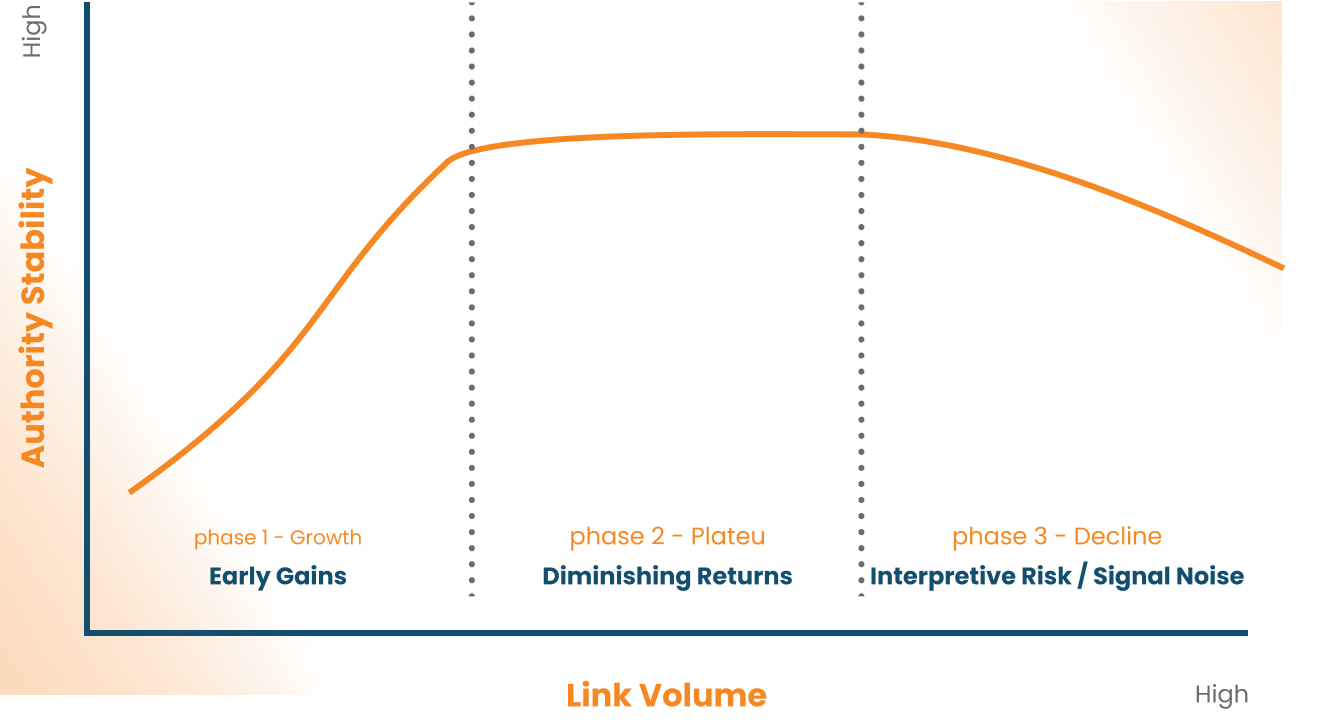
phase 1 – Growth
Early Gains
phase 2 – Plateu
Diminishing Returns
phase 3 – Decline
Interpretive Risk / Signal Noise
This is also where many teams misdiagnose the underlying problem.
When visibility begins to dip, the default reaction is often to increase activity. More links, broader outreach, and a higher volume of placements are pursued in an attempt to recover momentum. In practice, this approach frequently compounds the issue. Adding volume to an already inconsistent or unclear signal set rarely restores trust. More often, it increases noise and makes interpretation even harder for search systems.
What matters more now is alignment.
Links that sit within relevant editorial environments, support existing content themes, and appear as part of a consistent authority footprint behave very differently from links that simply meet metric thresholds. They are easier for search engines and AI-powered systems to interpret, and harder to discount or devalue over time.

The risk isn’t penalties anymore, it’s just a waste of budget.
George Blandford
CEO
This does not mean that scaling off-page activity is no longer possible. It means that scaling now requires control.
Effective off-page strategies increasingly prioritise:
- Fewer placements with clearer topical relevance
- Stronger alignment between on-site content and off-site references
- A deliberate mix of links and brand mentions that reinforce the same themes
- Controlled velocity that reflects genuine visibility growth rather than artificial expansion
In this context, volume becomes a by-product of credibility, rather than the driver of it.
Teams that continue to treat link quantity as the primary success metric often find themselves spending more simply to maintain the same level of performance. By contrast, teams that shift their focus toward relevance, consistency, and narrative alignment tend to see steadier outcomes, even as search systems and AI-driven discovery continue to evolve.
At this point, teams face a choice: keep scaling volume or reassess whether activity is reinforcing authority at all.
Authority is now interpreted contextually, not counted

One of the biggest sources of confusion in off-page SEO today is how authority is actually assessed by search engines and, increasingly, by large language models (LLMs) and AI-powered discovery systems.
For many years, the industry relied heavily on third-party metrics such as Domain Rating (DR) and Domain Authority (DA). These metrics became shorthand for quality. Higher scores were assumed to indicate stronger authority, while lower scores were often dismissed outright. In practice, these numbers shaped pricing, outreach decisions, and perceptions of value across the link building and digital PR ecosystem.
In reality, these metrics were never measures of authority in the way search engines interpret it. They are proxy filters, designed to enable faster assessment and to help publishers and link vendors assign relative value. They provide a rough indication of scale and link accumulation, but they do not explain whether a site is authoritative in any meaningful topical or contextual sense.
That distinction matters more now than it ever has.
Metrics such as DR and DA are still useful when applied correctly. They can help teams understand whether a site has an established backlink profile, whether links come from a variety of sources, and whether a domain has accumulated trust over time. What they do not tell you is whether those links contribute to visibility for relevant keywords or topics — which is the signal that matters far more in a modern off-page context.
Search systems are far less interested in how many links a site has in aggregate, and far more interested in what those links say about expertise, relevance, and trust within specific topic areas. In practical terms, this means that consistent keyword visibility and performance across related queries is a stronger indicator of authority than a high third-party score viewed in isolation.
A publisher with moderate DR — typically in the 20–35 range — but strong, consistent visibility across a defined topic area often carries more contextual weight than a high-DR site with broad, unfocused coverage. This is why links that look impressive in a spreadsheet sometimes fail to make a measurable impact on visibility, while others with lower headline metrics deliver disproportionate results and, ironically, receive little credit for doing so.
In this scenario, authority is inferred from topical alignment.
Search engines evaluate whether a site consistently ranks, appears, or is referenced for topics that closely match the destination being linked to. They look at how content performs across related keyword sets, how often the site is cited within a topical ecosystem, and whether those signals reinforce each other over time. Authority emerges from patterns, not from isolated metrics.
This is also why purely metric-led link selection introduces risk.
When link acquisition decisions are driven primarily by DR, DA, or similar proxy scores, relevance often becomes secondary. Over time, this creates a backlink profile that may appear strong numerically but lacks a clear topical foundation. As outlined earlier, profiles like this tend to stagnate or underperform as search systems become more interpretive and less tolerant of ambiguity.
This shift reflects how search systems already behave.
They do not treat authority as a universal score that transfers cleanly from one context to another. That model belonged to a PageRank-dominated world. Today, authority is interpreted within topical relationships. Signals that reinforce those relationships compound to improve visibility. Signals that contradict, dilute, or scatter them introduce uncertainty, stagnation, or complete lack of visibility.
This thinking is central to how we approach link evaluation internally.
Frameworks such as M-Flux were created to move beyond single-metric decision-making and toward a more balanced, relevance-led assessment of quality. Historically, this has meant weighting multiple signals and applying manual checks to reduce risk. A future iteration of M-Flux, currently in development, will go further by assessing not only individual placement quality, but also the backlink profiles of publishers themselves.
If a placement only looks good in a spreadsheet but doesn’t make sense to the audience, it probably doesn’t make sense to the algorithm either.
George Blandford
CEO
The goal is to understand a publisher’s strengths and weaknesses in relation to topical relevance, not just raw authority. In other words, it is less about how powerful a site appears based on misplaced credit from DR or DA, and more about where that power actually sits in a modern, topic-driven context.
For teams managing off-page SEO today, the implication is straightforward.
Metrics should be used to filter and prioritise, with relevance as a primary marker — not to decide in isolation. The real question is whether a link helps reinforce visibility and credibility for the topics that matter to the brand. If it does, it contributes to authority. If it does not, its value is limited, regardless of how strong it looks on paper.
This relatively simple change in process can save thousands in wasted link building and digital PR spend, and it is long overdue.
Authority, in this context, is inferred from topical alignment.

George Blandford
CEO
In SEO, simplicity sells, but authority doesn’t behave simply. It isn’t transferable in bulk, and it isn’t universal. If a link or PR placement doesn’t reinforce how a brand should be understood by the right audience, it doesn’t strengthen authority. That’s where most wasted spend comes from, and it’s usually invisible until performance stalls.
Links, mentions, and entity signals work together

As discussions around AI-powered search and large language models (LLMs) have accelerated, one debate has become increasingly common in SEO circles: do links still matter, are mentions now important, and which of these signals is more valuable?
The short answer is that this line of questioning is flawed.
Links, mentions, and broader entity signals perform different functions, and modern search systems increasingly evaluate them together rather than in isolation.
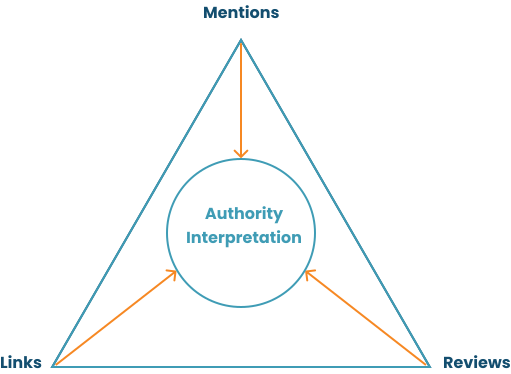
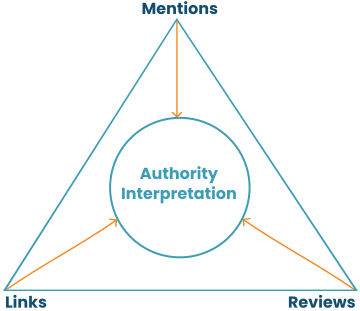
This has always been true to some extent, but it becomes far more pronounced in AI-powered search features that summarise, compare, and recommend brands rather than simply rank individual pages.
Links remain a core signal within search. They help search engines discover content, understand relationships between pages, and assess trust at a technical level through mechanisms such as PageRank. Mentions, by contrast, help systems understand that a brand exists, how it is discussed, the contexts in which it appears, and how frequently it is referenced. Reviews, citations, and recurring brand references across video platforms and social environments such as Reddit further reinforce that understanding by providing additional linguistic and contextual signals.
In AI-assisted search environments, this distinction becomes even more important.
LLMs do not operate like traditional ranking systems. They generate answers by synthesising information across many sources to form an understanding of entities, topics, and relationships. When AI-powered features surface summaries such as “best providers,” “trusted companies,” or “recommended platforms,” they are not simply retrieving the strongest linked page. They are drawing on patterns formed through language, repetition, and contextual agreement across a wide range of sources.
As a result, authority as interpreted by AI-powered systems is shaped primarily by consistent narratives around a brand, with link equity likely playing a lesser role than it has historically played in traditional ranking systems.
A brand that appears repeatedly across relevant articles, reviews, videos, comparisons, and discussions is easier for an AI system to recognise, describe, and recommend accurately. These systems build a probabilistic understanding of which brands belong within a given category based on how often they are referenced, how consistently they are described, and whether those references align around the same topics and use cases.
Conversely, a brand with a strong backlink profile but a limited mention footprint outside of SEO-driven placements can be difficult for AI-powered systems to contextualise. The links may exist, but the surrounding language does not reinforce a clear topical identity. As AI-generated features expand, this gap becomes increasingly visible.
This does not mean that unlinked mentions replace links.
Links continue to provide structure and foundational trust. Mentions provide reinforcement and meaning. Reviews, citations, and discussion validate real-world relevance. When these signals align around the same topics, authority compounds. When they diverge, interpretation weakens.
This is where digital PR plays a critical role — and also where it often goes wrong.
Digital PR activity that generates coverage without relevance, without topical focus, or without continuity may increase brand visibility in the short term, but it does little to strengthen topical authority. In some cases, it actively introduces confusion by associating a brand with subjects it does not want to be known for. A common example would be a home insurer being mentioned in a “UK’s 20 Most Haunted Houses” article. The coverage exists, but it does nothing to reinforce authority within insurance-related topics.
From an AI perspective, this kind of coverage is not neutral. It adds noise. It creates mixed signals about what a brand represents and where it should be surfaced. Over time, that noise makes interpretation harder rather than easier.
Effective digital PR works differently.
Rather than chasing coverage for its own sake, it reinforces entity understanding by placing brands within the right conversations, alongside relevant peers, and in environments that already demonstrate topical credibility. Whether every placement includes a link becomes secondary to whether the coverage supports a consistent and recognisable narrative.
AI-powered search features reward this consistency.
When systems are asked to summarise or recommend brands within a category, they look for recurring, aligned references across trusted sources. Links help establish credibility. Mentions help define meaning. Consistency determines whether a brand is confidently included or quietly ignored.
For teams focused on future-proofing off-page SEO, the implication is clear.
Links should not be pursued in isolation from PR, and PR should not be executed without regard for SEO. Both contribute to how authority is interpreted by traditional search engines and AI-powered systems alike. The objective is not to optimise for a single signal, but to ensure that all off-page signals reinforce the same topical identity over time.
Jason Brooks
Founder
The surprise to many is that they probably always mattered, it’s just that the market had tunnel vision around do-follow links. To suggest to a client that a mention made a difference would have been professional suicide. Digital PR and the 2024 leaks made it clear that text mentions shape how search engines understand a brand.
Digital PR as authority reinforcement and risk reduction

Digital PR is often described primarily as a visibility channel. Coverage, reach, impressions, and referral traffic are commonly used to justify spend and measure success. While visibility still has value, this framing is increasingly incomplete and, in many cases, misleading.
In a modern search environment, digital PR’s most important role is not exposure. It is authority reinforcement and risk reduction.
Search engines and AI-powered search features are now far more interpretive than they were even a few years ago. Google’s AI Overviews, product and service comparisons, “things to know” panels, and conversational search results all rely on summarising and synthesising information from multiple sources. Large language models used in tools such as ChatGPT, Gemini, and Perplexity operate in a similar way, forming responses based on patterns observed across a wide range of content rather than ranking a single page in isolation.
These systems are not simply retrieving the strongest page for a query. They are forming an overall view about which brands are credible, relevant, and safe to recommend within a particular topic or category.
This is where digital PR becomes strategically important.
PR placements influence how a brand is described, where it appears, and which topics it is repeatedly associated with. When those placements are topically aligned, consistent, and credible, they reduce uncertainty for both search engines and AI-powered discovery systems. They help reinforce what a brand does, how it should be understood, and where it belongs within a broader market or category.
When digital PR is executed without a clear strategy, however, it can do the opposite.
Coverage that is disconnected from a brand’s core offering may generate short-term attention, but it increases interpretive risk. From an AI perspective, it introduces conflicting signals. A brand that appears across unrelated themes becomes harder to categorise, harder to summarise, and less likely to be confidently included in AI-generated answers, comparisons, or recommendations.
This matters because AI-powered features increasingly shape user behaviour before a click ever happens.
Users are now exposed to brand shortlists, summaries, and comparisons directly within search results. They ask conversational queries such as “Which companies are trusted for X?” or “Who are the best providers in Y?” In these scenarios, only a small number of brands are surfaced. Inclusion is no longer just about ranking position. It is about being recognised as relevant and credible enough to be mentioned at all.
Digital PR supports this recognition when it is done correctly.
Consistent coverage in relevant publications helps establish topical authority. Mentions in expert commentary, industry explainers, reviews, and comparison content all contribute to how a brand is understood within its niche. Over time, these references create a clearer and more stable entity profile — one that AI-powered systems can summarise and describe with greater confidence.
This is also where digital PR plays an important role in reducing risk for traditional SEO.
Brands with strong, consistent PR footprints tend to be more resilient through algorithm updates and periods of volatility. Their authority is distributed across multiple reinforcing signals rather than concentrated in a narrow set of links. If one signal weakens or is reinterpreted, others continue to support credibility and visibility.
By contrast, brands that rely heavily on links without supporting PR activity often find themselves exposed. When link value is discounted, reweighted, or reassessed, there may be little else reinforcing authority or trust.
Effective digital PR therefore acts as a stabiliser.
It does not replace link building. It supports it. It ensures that when links are evaluated, they sit within a broader context of recognisable authority signals. This alignment makes off-page profiles easier for search engines and AI-powered systems to interpret — and harder to ignore.
For teams planning off-page strategy today, the key question is no longer how much coverage a PR campaign generates. It is whether that coverage consistently reinforces the topics, expertise, and positioning the brand wants to be known for.
When digital PR is treated as authority reinforcement rather than simple exposure, it becomes one of the most effective tools for long-term visibility and risk management across both traditional and AI-driven search environments.
Who this approach works for and where it breaks down

Relevance-led authority building is not limited by sector. In principle, any business can benefit from being clearly understood, consistently referenced, and accurately represented across traditional search engines and AI-powered discovery systems.
In practice, however, whether this approach works comes down less to industry and far more to operational readiness.
The teams that see the strongest outcomes are not necessarily those with the largest budgets or the most aggressive link acquisition strategies. They are the teams able to plan, execute, and evaluate off-page activity with discipline, restraint, and a long-term view of authority rather than short-term output.
WHERE THIS APPROACH WORKS WELL
Relevance-led authority building works best for teams that have several core capabilities in place.
Clear understanding of their topical lane
The brand knows what it wants to be known for and where it should be visible. Commercial priorities, content themes, and PR narratives are aligned. This clarity makes it far easier to judge whether a link, mention, or placement reinforces the right topics or introduces noise that dilutes authority.
Willingness to assess relevance, not just metrics
The team can move beyond DR, DA, or raw link counts as primary decision-makers. Metrics are still used as filters, but relevance, audience alignment, and a publisher’s actual keyword visibility carry more weight. This enables more informed judgement when selecting publishers, content formats, and narrative angles.
Controlled, patient execution rather than volume-led output
There is no pressure to hit arbitrary placement targets simply to demonstrate activity. Campaigns are judged on quality, alignment, and consistency rather than quantity. This creates space to reject opportunities that look impressive on paper but do not support long-term authority building.
Integration between SEO and digital PR
SEO and digital PR are not treated as separate or competing functions. Messaging, link targets, and coverage are coordinated. As a result, links, mentions, and content reinforce each other naturally, rather than arriving in isolated clusters that are easy for search systems to discount.
Tolerance for delayed or indirect impact
The team understands that authority reinforcement does not always produce immediate ranking gains. Success is measured through indicators such as stability, sustained visibility across relevant queries, brand recall, and inclusion in AI-powered features over time — not just short-term movement.
WHERE THIS APPROACH BREAKS DOWN
This approach tends to struggle when day-to-day delivery pressure outweighs strategic thinking.
Deliverables are treated as the primary KPI
If success must be demonstrated through simple monthly totals — links built, DR achieved, or placements secured — relevance-led decision-making becomes difficult. Pressure to show activity often leads to compromised quality. This is a common trap, particularly where smaller agencies rely on white-label providers or link marketplaces. In these situations, control is reduced, risk is passed downstream, and clients ultimately absorb the downside while intermediaries profit.
Inflexible execution
When targeting, messaging, or publisher selection cannot be adjusted in response to performance signals, the same tactics are repeated regardless of outcome. Over time, this leads to diminishing returns and an accumulation of misaligned signals that weaken authority rather than strengthen it.
Over-reliance on automation
Automation can accelerate discovery and filtering, but it cannot replace judgement. When publisher selection or outreach becomes fully automated, topical relevance is often the first thing to degrade. At scale, this creates efficiency at the cost of clarity.
Lack of cross-channel coordination
When SEO, PR, content, and brand operate independently, off-page signals fragment. Links point in one direction, PR coverage in another, and AI-powered systems struggle to form a coherent understanding of what the brand actually represents.
Fixed expectations around timing and certainty
Teams that expect guaranteed outcomes or fixed timelines often push for shortcuts. Authority building reduces risk over time, but it does not offer certainty on demand — particularly in AI-driven search environments where interpretation and inclusion matter as much as ranking position.
A PRACTICAL TEST OF READINESS
A simple way to assess whether this approach is a good fit is to ask one question:
What do we — or our clients — actually care about when acquiring third-party links and mentions?
If the answer centres primarily on numbers and proxy metrics, the foundation is weak. If it references relevance, audience fit, visibility for meaningful topics, and long-term brand perception, the team is well positioned to benefit from a relevance-led authority framework.
Authority is an ongoing risk decision

Authority is no longer something a brand builds once and then benefits from indefinitely. It is something search engines and AI-powered discovery systems continuously interpret and re-interpret based on the signals they observe over time.
Links, mentions, PR coverage, reviews, and wider discussion all contribute to that interpretation. Individually, each signal carries limited meaning. Collectively, however, they shape how confidently a brand can be understood, categorised, and surfaced. When these signals are aligned, they reduce uncertainty and reinforce credibility. When they are misaligned, they introduce noise and increase risk.
This shift is subtle, but it is important.
Off-page SEO is no longer just about pushing for growth or accumulating signals as quickly as possible. It is increasingly about protecting how a brand is understood across traditional search results, AI-generated summaries, recommendations, and comparisons. As search systems become more interpretive, the cost of inconsistency rises.
Metrics still matter, but only in their proper role. They are useful as filters and sense checks, not as decision-makers. Volume still plays a role, but only once relevance and consistency are already in place. Digital PR still delivers exposure, but its most durable value lies in reinforcing topical authority rather than chasing attention or reach for its own sake.
In this environment, authority is best thought of as a risk-managed outcome, not a mechanical input.
Every off-page decision — whether a link, a mention, or a PR placement — either reinforces how a brand should be understood or introduces ambiguity. Over time, those small decisions compound. Some brands become easier for search engines and AI systems to interpret, trust, and recommend. Others become harder to place with confidence, even if they continue to generate activity.
The brands that perform best over the long term are not those doing the most off-page activity. They are the ones making fewer, more deliberate decisions about where they appear, how they are described, and which topics they consistently reinforce.
That is what modern authority building looks like.
Appendix A:
The off-page authority risk framework

The purpose of this framework is to help teams evaluate links, mentions, and digital PR placements through an authority and risk lens, rather than purely through volume or third-party metrics.
It is designed to be used before approving activity, not retrospectively to justify spend.
The framework reflects how modern search engines and AI-powered systems interpret off-page signals: contextually, cumulatively, and conservatively.
HOW TO USE THIS FRAMEWORK
For any proposed link, mention, or digital PR placement, answer the following five questions honestly.

TOPICAL ALIGNMENT
- the subject matter of the publisher
- the theme of the content
- whether the placement strengthens a clear topical association
If the placement sits outside your core topical lane, it is unlikely to reinforce authority.

AUDIENCE RELEVANCE
- who actually reads or engages with this content
- whether the audience overlaps with your target market
- whether the placement serves users, not just algorithms
Authority is inferred through relevance to real audiences.

NARRATIVE CONSISTENCY
- how the brand is framed
- the language used around the brand
- whether the placement reinforces or dilutes your intended positioning
Inconsistent narratives introduce interpretive risk.

SIGNAL INTERACTION
- whether the placement reinforces an existing cluster of signals
- whether it contributes to a recognisable pattern
- or whether it appears as a one-off
Authority compounds when signals interact.

DOWNSIDE RISK
- whether the placement adds noise
- whether it introduces contradictory associations
- whether losing it would damage understanding
If the downside risk is high, the upside must be very clear.
This framework is deliberately simple. Its value lies in forcing clarity before activity takes place, not in generating scores.
Appendix B:
The signal alignment matrix
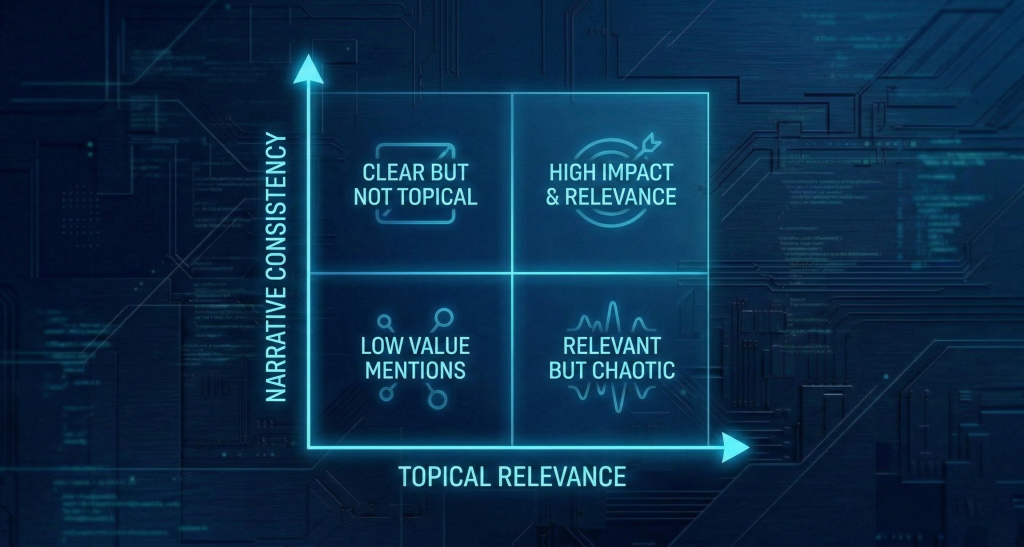
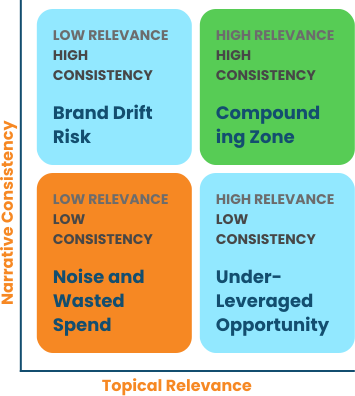
This matrix helps teams visualise why some off-page activity compounds authority while other activity dilutes it.
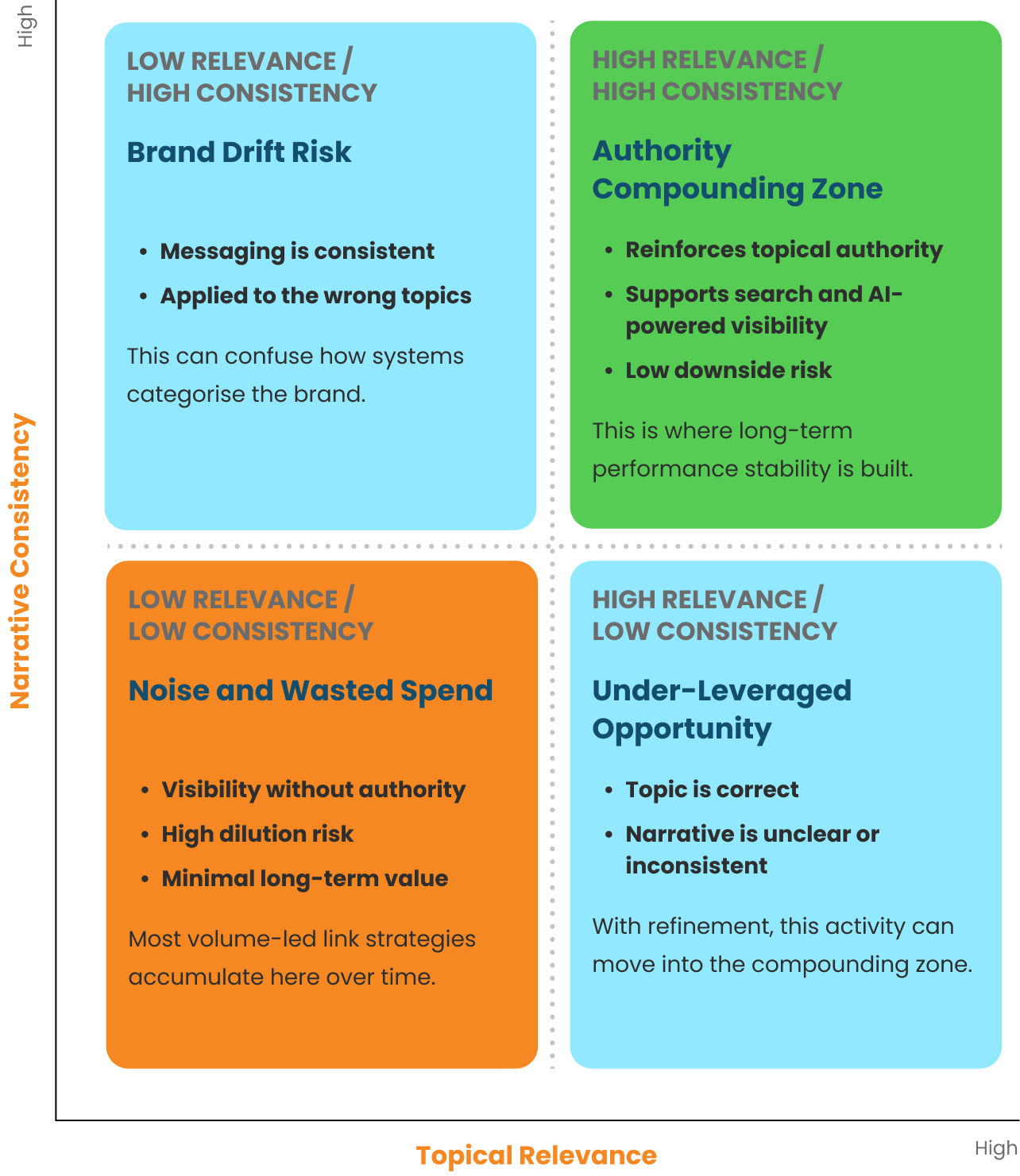
LOW RELEVANCE / HIGH CONSISTENCY
Brand Drift Risk
- Messaging is consistent
- Applied to the wrong topics
HIGH RELEVANCE / HIGH CONSISTENCY
Authority
Compounding Zone
- Reinforces topical authority
- Supports search and AI-powered visibility
- Low downside risk
LOW RELEVANCE / LOW CONSISTENCY
Noise and Wasted Spend
- Visibility without authority
- High dilution risk
- Minimal long-term value
HIGH RELEVANCE / LOW CONSISTENCY
Under-Leveraged Opportunity
- Topic is correct
- Narrative is unclear or inconsistent
HOW TO USE THE MATRIX
Plot proposed placements mentally before approving them.
If activity repeatedly lands outside the compounding zone, the strategy needs reassessment — regardless of headline metrics.
Appendix C:
Using this framework with ChatGPT
The Off-Page Authority Risk Framework can be applied quickly and consistently using ChatGPT as a decision-support tool.
This does not require:
- API access
- live metrics
- proprietary data
It relies on structured reasoning, not automation.
WHAT THIS IS (AND IS NOT)
This use of ChatGPT is:
- a second opinion
- a consistency layer
- a way to reduce cognitive bias
It is not:
- a ranking predictor
- a link scoring tool
- a replacement for human judgement
SUPPORTED USE CASES
1. BEFORE APPROVING A PLACEMENT
To sanity-check relevance, narrative fit, and downside risk before budget is committed.
2. AFTER A PLACEMENT IS LIVE
To assess likely impact, determine whether the placement is reinforcing, neutral, or dilutive, and decide whether additional signals are required to offset risk
PROMPT OPTION FOR USERS (FRAMEWORK-ALIGNED)
Users should instruct ChatGPT to:- evaluate placements using topical alignment, audience relevance, narrative consistency, signal interaction, and downside risk
- default to caution when information is missing
- adapt recommendations depending on whether a placement is upcoming or already placed
- avoid certainty, scoring, or predictive claims
PROMPT OPTION FOR USERS (FRAMEWORK-ALIGNED)
Users should instruct ChatGPT to:
- evaluate placements using topical alignment, audience relevance, narrative consistency, signal interaction, and downside risk
- default to caution when information is missing
- adapt recommendations depending on whether a placement is upcoming or already placed
- avoid certainty, scoring, or predictive claims
This appendix is intentionally aligned with the UK Linkology Authority Risk Assessment Custom GPT, ensuring consistency between:
- manual application
- ChatGPT-assisted reasoning
- Custom GPT behaviour
Appendix D:
The UK Linkology authority placement & risk assessment custom GPT
The UK Linkology Authority Placement & Risk Assessment Custom GPT is a structured decision-support tool built to apply the authority and risk framework outlined in this document.
It exists to help teams evaluate links, mentions, and digital PR placements properly — before money is spent and after activity goes live.
WHAT IT IS DESIGNED TO DO
The Custom GPT applies the same five principles defined in Appendix A:
- Topical alignment
- Audience relevance
- Narrative consistency
- Signal interaction
- Downside risk
Its role is simple: To stop teams making volume-led decisions that weaken authority over time.
It helps surface ambiguity, highlight misalignment, and force structured thinking. It does not score links. It does not predict rankings. It does not replace judgement.
It reinforces discipline.
WHAT IT IS NOT
The Custom GPT:
- Does not guarantee results
- Does not control search engines or AI systems
- Does not replace strategic thinking
- Does not remove the need for human oversight
We do not claim to train or influence LLMs directly. This tool improves decision quality. That is its purpose.
WHAT IT IS NOT
BEFORE APPROVING A PLACEMENT
Use it to assess:
- Whether a link or PR opportunity genuinely reinforces topical authority
- Whether the publisher’s strength aligns with your commercial focus
- Whether the placement introduces narrative drift
- Whether the upside clearly outweighs the downside risk
This is where most wasted budget can be avoided.
AFTER A PLACEMENT IS LIVE
Use it to evaluate:
- Whether the activity is reinforcing, neutral, or dilutive
- Whether supporting signals are required
- Whether the campaign is building coherence or adding noise
It reframes the question from “Did we get coverage?” to “Did this strengthen authority?”
HOW IT FITS WITH M-FLUX
M-Flux was created to move beyond single-metric decision-making. The Custom GPT extends that philosophy. Where M-Flux helps filter and assess site quality, this tool reinforces contextual judgement:
- Is this aligned?
- Does it make sense?
- Does it support how we want to be understood?
Used together, they reduce risk and improve consistency.
WHY THIS MATTERS NOW
Search engines and AI-powered systems interpret authority contextually. They look for patterns, reinforcement, and clarity.
When off-page signals align, authority compounds. When they diverge, interpretation weakens.
This tool exists to help teams make fewer, better decisions — and avoid activity that looks good in a report but adds no real authority.
If we have to convince ourselves a placement makes sense, it probably doesn’t. This tool forces clarity before budget is committed.
Jason Brooks
Founder
FINAL POSITIONING
This Custom GPT is not a shortcut.
It is a discipline tool.
Used correctly, it helps teams protect authority, reduce wasted spend, and build visibility that holds up as search systems continue to evolve.